Tuesday, 19 August 2025

Throne of the Forest - 3rd Canto

This is the final Canto from my work, "Throne of the Forest". 


I published Canto 1 - on 1st of Jan, 2021 / 31st of December, 2020 (Depending on where you were in the world, and how you think timezones work)
I wrote Canto 2 - on May 28th, 2021
And now. I've finished Canto 3 - On August 20th, 2025

I know I was working on a LOT of different project in the middle there, including but not limited to my forays into art, painting, music, writing PROSE, and even other poems.

That said, I am glad that this is finally finished - and that this one has turned out the way it has. 


As always - please tell me what you think, and where improvements can be made. 


For reference - Part 1 can be found [Here] and Part 2 can be found {Here}


III:

Beneath skies, darkened by raven wings,
thunder rolled under marching hooves.
An end to our tale this cold wind brings,
where the final pieces now make their moves.
Soldiers marched along paths set in stone,
spurred on by stories, rumours and tales,
thralls of fear, following folly alone,
with malice hidden well beneath their veils.

Before stone city gates, the army now stood,
around their feet danced magic and tune.
The King started his tale, steeped in falsehood,
to enter the forest - he cried for this boon.
But ghostly echoes played about the livings' lips,
"Kingly one, or cowardly one, no more distinct,"
Jarred by the reply, the mask fades and slips,
"To axes! To arms!", but his bravado blinked.

Though useless the command, the people still fled,
and neither burns nor steel could hinder their flight,
deep into the forest, from whence music had spread,
and thorns grew violent, with unstoppable might.
They tried to pursue, determined in their campaign,
but the woods swallowed them whole, horses and all.
Their failures repeated, lives and efforts in vain,
as the forest lay unyielding to both King and his call.

At the end of this long march, only two now are left,
a chain of spilled blood, fanged and forged in fear,
a king of no status, and his garbs now bereft,
bloody and barefoot, to the final stage they appear.
A clearing now revealed to this surviving spectre,
a bounty in wait, of magic, foods and orchards,
he ignored them all, dragging his remains to the centre,
to a giant tree where stood giant beasts like stewards.

Deep into the tree was carved an exquisite throne,
which held the bones of the forest's guardian child,
who had led a full life, devoid of gripe or groan,
and whose love for the forest grew it lush and wild.
Prophecy now fulfilled, and the dread king knelt,
defeated entirely by a ghost of his own making,
who lifted no finger, merely using which fate had dealt,
as the mad king's spectre fell before the forest's king.


Friday, 5 January 2024

Nostalgia / Change

I have no excuse for my absence - I have a real life with work and deadlines, sadly. 

Hoping that you all are doing well.  

In the mean time, during one of our many breaks, another poem for everyone to enjoy.


I wanted to talk about the themes of Change, how inevitable it is; How people often times find it difficult to let go of events, even obsessing over things in a way that you glorify parts that you shouldn't. 
For me, it was also about Acceptance and moving on from negative thinking. 

Tell me what you think. Where I can improve. 


Nostalgia / Change:

Times will come, so full of change, 
Walking a journey which we all must make. 
To travel along, and to turn the page, 
Of life's long stories our lives all take. 

Beholden only to time's twilight hours, 
The fool sees none of the brighter lights, 
Imprisoned within old dreams' powers,
In vain attempts to relive old delights. 

Faded pasts held firmly in embrace, 
Ignoring paths that remain unspoiled, 
Failing to see new paths full of grace, 
As fear and memories hold us coiled. 

For better or worse, time marches on, 
And so too must we, along river's thread, 
Where the past, in dreams, is now long gone, 
With futures free of the nightmares' dread. 

Friday, 22 July 2022

Of the Ristvig - "Tower of Hal"

Hello. It has been nearly a half year since I last published anything, but life had taken a hold of... my life? If you could say that. 
A new job, associated complications, timing issues, and the ever dreadful writers block that has plagued my poetry since. 

However, that is not to say that I have not been creating. I just haven't been able to finish certain poems - a few of which I've started, including the long overdue final canto to my "Throne of the forest" piece. 

I have in that time, taken up drawing as an art form, and been posting what I've made on to my socials, and shared with others online. Its, quite frankly, unmissable. 


I have also been writing, and that is what I would like to share with you now. But first, a small introduction. 

In my book, there exist a faction, called the Ristvig (Of the storytellers) - created by a figure called Saru. In his old age, he had two great fears: First that his time was drawing to a close, and secondly, that the stories he collected, the sights he had seen, and the events he experienced over the centuries would be lost to the ages, or worse, manipulated by retellings. To help with this, he formed the clan of the storytellers and history keepers - the Ristvig.

So he set out, one last time, knowing that his end was near, breathing magic into the stones he stepped on, the caves he rested in, and into the stars that looked down on him from the heavens.

When he had last finished his journey, he, surrounded by the first clan of the Ristvig, bade his farewell to his original people, and walked hand in hand with the Death-bonded, to Stade Del (the city of lights).

These places would glow under the starlight on the eve of his passing, for all to see without restriction. They showed his memories, his thoughts, and his writings - sharing the histories of these places without reserve. Be these stories bloody, and without mercy, or the greatest of triumphs, and filled with hope, they would all be visible, and incapable of change, or destruction. 

But what is the role of the Ristvig? Along with the physical preservations, called "Saru's Will", the people also formed a verbal history in their stories - that which would be passed down through the clan over the years, preserved over the ages by being verbatim recreations of the original stories and histories.


So that comes to our story today: "The Tower of Hal". 


    "The Tower of Hal?" Enquired Nova. "How does that tale go?"
    Aeon cleared his throat and began. "In the deserts of the north, beyond the great underground cities of Ut and Thar, there is a single outpost made of stone. It stood tall, tall enough that you could stand on the surface of the lands above the cities of Thar, the northernmost city of Lytherine, and see it in the mirage above the sands. A thin line, that seemed to phase in and out of reality as the air around it burned and danced.
    "Explorers would venture far, but the tower was always too far away. No matter how early you started your journey at the shores of the great sand-sea, you would never reach it before spending a whole day and night travelling. The tower itself was made of plain stone and remained unadorned and unremarkable. No sigils adorned the walls, and the walls inside were bare. Each layer, or floor, of the tower had simple ledges going around it on the outside, made of a yellow stone, unlike the red stones in the walls of the tower. 
    "But these were never the reason why many people visited this site, so far out of the way, and deep within the sand-sea of the north. 
    "Nowhere else in the sand-sea grew any vegetation, but the ground around the tower was always lush. The land would be wet, the trees tall and evergreen, and the wildlife very protective. Even the first explorers saw the great baboons who would scream their welcomes from the tree tops. They never once harmed the visitors, but they would never let you out of their sight. When we," he stopped himself. The way the Ristvig spoke their narrations were verbatim recounts, though allowing for small changes, such as pronouns, in the retellings. "When Saru was there first," he corrected himself, "He stayed there for six full days. He brought with him water, food, books and writing implements. The baboons were excited to see the pack animals, and the group he brought with him was no small size either."
    He resumed, "The floor of the towers, like the walls, were bare, but that was never a problem for the travellers, who were prepared for anything. Almost everything, it should be said. The water and food would run shorter because of the heat, and because kindness allowed them to give some shares of their rations to the baboons around them. The baboons would peek in through the windows, looking at the companions, chattering among themselves. At sundown, they would all collectively go to the roof of the tower and look north, sitting there till the sun fully vanished. Saru would stand with them after the third day, once he noticed where they would disappear to.
    The kindness of his and his companions bore its own fruit. Once the food had started to dwindle, the baboons would bring in vast horde of fruit for the travellers, and come nightfall, past the third hour of the moon, would habitually steal their water skins to go refil them. No one could find where these gifts came from, however hard they searched, or how high they climbed. The water would always be pure and clean, and the fruits fresh and perfectly ripe." he concluded. 
    "So where does the name of the tower come from? Did Saru and his companions name it?" enquired Nova. 
    "When the explorers all reached the seventh and final floor of the tower, they came across an inscription, etched with magic. It would always read in the person's most preferred language, and it was legible and visible in even the darkest night. 'Here was the last place of rest for Hal, who travelled further north. Though we may be lost in this sea, this sanctuary shall provide for those who need it, and only those in need. May neither time, nor sands swallow my pride, or harm those who make it their home.'
    "People speculated that this mysterious Hal wandered North, filled with great determination and with great strength, but never returned, which is why the baboons still watch on the rooftops, facing the north, waiting for him."
    "Is that what you believe?"
    "Generations of baboons all holding out hope to see a single person return from the north? I don't know. Then again, do we know how communities of animals maintain their own histories? I believe that it could have been true initially. 
    "What I find most interesting is the way the magic interprets the message in its translation. It could have been Hal, or Hala. Hal meaning 'leader' or 'One who escapes a brutal fate', while Hala would mean 'Halo around the moon', or 'One who sees through the night'. For the creator of this tower, all names and titles would be fitting." Aeon thus ended his tale. 


Please let me know what you think. 
I will be posting more of the stories of the Ristvig, as I write them. 
I shall also be returning to poetry when I can, and I am posting my drawing on my socials as when I complete them. :)

Take care. 
Have a great week. 

Monday, 31 January 2022

Yet, Hope Remains

 I realise that I havent posted anything since July of last year. 
Unfortunately, there have been other things that had taken the forefront of the space allotted in my brain. 
Some emotional (Judging by the last poem I DID write). 
Some work related (Yes, I had a change in careers. From "unemployed" to "employed")
All momentous. 

Incidentally, I've also started drawing more. 
Much like poetry, It was not a skill I thought I possessed. 
But here we are, and we are working on improving that as well. Unlike the poems, I wont be posting the uploads here, as of now - they're all on my instagram, among other entries. 

But I am here today, once more, for a new poem. I am still working on the final part of "Throne of the forest" and nearing completion. So instead, I present to you a different poem, one more allegorical in nature. 

This one is called "Yet, Hope Remains". The inspiration comes from the notion of "The light will come eventually", and how to get through the night. I've had these days and nights, especially recently, so anecdotally at least, that the light eventually comes back. 

As always, please let me know what you think, and where I can improve. 

I'll try and keep the writing a bit more consistent as well, on my part. 

Take care, 
Critique, 
And have a great week. 


"Yet Hope Remains"

Lights are dim, and falling fast:
Twilight falls on flailing wings.
Yet, hope remains. Though, will it last?
Through this song the darkness sings. 

'Ere dawn returns, we breathe the cold,
in shallow breaths, and beating hearts.
Yet, hope remains, as tales unfold,
in songs of dark skies as lights departs.

Blushing skies, with crimson streaks,
and thousand voices awake at last.
Yet, hope remained, under starry peaks,
as we sing now, that the darkness passed. 


Wednesday, 21 July 2021

I keep on hoping that I'll see you one day - Poem Out of Rhyme

This poem is, again, in a style that I am not used to, and I thought that I would give this a go. 
Originally I wasnt going to post this or publish this anywhere, but I was convinced by some of the most important people in my life. 
So to them, I thank you most sincerely, dear ones. I dont make it a habit of naming names on this blog, so I apologize and hope that for now this suffices as a dedication to you. But the support from when I shared this initially was surprising and very much staggering. Thank you to my Valkyrie, who inspired part of "Lullaby" as well. :) 


It was inspired by some personal experiences, but mostly by tropes and music and literature like "La-La Land", "Just One Yesterday" - Fall Out Boy, and a few others. 


With this poem, Its not one of my usual ones with the rhyming couplets, but I DO hope that you enjoy it, and that it evokes something within you in a positive way. 

I keep on hoping that I'll see you once more one day,
In hotel bars,
In Airport lounges,
In the pouring rains,
across a crowded way,
All with a single look shared between us
Like they do in the movies, and in books,
And in that moment, the years disappear.
I keep on hoping to see you once more,
because why not?
If the stereotypes and tropes were hungry enough before
To separate and to tear us to pieces,
Were they full when I was devoured?
If the fates were cruel then, would they not be cruel again?
To bring two strangers with memories, to new shores,
Only to be passing by in ships moving in opposite directions.
Since when were they kind? And why start now?
Why not create a new meal to devour and consume.
But even with all that pain.
I wish that we could see each other once more.
For the fool in me still lives on
through death
through pain
Through every wound I ever inflicted on myself
and through every whispered name I never said.
I keep on hoping that I'll see you one day. 

Friday, 28 May 2021

Throne of the Forest - 2nd Canto

 As mentioned earlier, this is a poem that is based off an original story written earlier. 

You can find the previous Canto in my blog as well, if you've missed out on it. 

This is the second Canto, of an intended three.

For reference -  Part 1 can be found {Here} and Part 3 can be found [Here] 

Please enjoy. Let me know what you think. 
Where I can make improvements. 
Etc. 


II:

Under sea of stars the story resumes,
Nameless babe woken by nameless sound,
Surrounded and swaddled in colourful blooms,
The night leans in, it's touch unbound.
Rocking it's cradle, spurred by magic of blood,
So child be safe, with naught else around,
Disturbed no more, by either crash or thud,
It resumes it's romp, through dreams abound. 

On empty plains, a single house now stood,
With words of magic stained within planks and panes,
To hold the child, who's bloodline withstood,
To protect him from all the world's aches and pains.
While magic met needs when needs were dire,
He learnt from pages in author-less tomes,
How to wield seeds, and even tame fire,
To breathe life from soil, and grow new homes.

Magic that persisted, sewn into skin of the child,
Protecting him from the loss of loved ones gone,
Gave instead to care, a family far more wild,
In animals of the forest, for company, to fawn.
As farmer, he grew at the house in the glades,
As farmer, he grew the glades most strong.
Springing with vigor, a forest like palisades,
Grew with it the animals as years danced along. 

As forest grew strong, so too did the magic,
Overflowing and spreading like notes and tunes,
Till a nearby town noticed a music most ecstatic,
And danced inside to claim the forest's fortunes.
Reaching no depths, stopped by monstrous woods,
And beasts so big and no fear in their eyes,
They beat a retreat, carrying their goods,
Running from magic of notes: lows and highs. 

Word quickly spread, travelling extremely far,
To rest at the foot of the old king's throne,
Of a forest of plenty, and giant beasts seen afar,
And the room was filled with a silent groan.
Family grew distant as the silence spread,
And madness flared once more in the old king's eyes.
The creaking began anew, of chains of the dead,
And armies he summoned, to go claim his prize.

Sunday, 25 April 2021

Whispers in the wind (which no one hears anymore)

This is a much shorter poem than my usuals, and the style is different as well. 
I'm trying something new, something that looks and feels a little more "modern". 

Enjoy. :)

From the bright star, 
comes imagination,
To righteous anger turning,
Into thoughtless wishes.
Burning bridges,
To when it all stops hurting,
A world in alteration,
That lives in a faded scar.


(Also, the second canto from "Throne of the Forest" is in the works. I know I've been taking my sweet time writing, but know that it's in the works.)

Let me know what you think, and how I can make improvements. 

Thank you, 

Thursday, 31 December 2020

Throne of the Forest - 1st Canto

This is a poem based off an original story that I have written recently, called "Throne of the Forest". 
Its supposed to be a folklore type of story. 

Instead of posting it as a story, however, I'm making it as a poem. 


This is the first Canto, of an intended three. 
For reference -  Part 2 can be found {Here} and Part 3 can be found [Here] 

Please enjoy. Let me know what you think. 
Where I can make improvements. 
Etc. 


I:

A kingdom's death comes at the end of blood,
Staining fear guided hands of the fated king.
The family fled through famine and flood,
Alas, as cat chases mouse, no use in hiding. 
They pleaded with the king, vowing no threat,
Bloodline will remain, under fealty to throne.
But old and wary, in fear of regret,
The king persisted, with heart of stone. 

A lesson learned and lessons passed on,
To kin of those killed for their bloodline:
Of a king who hunts, and lands long gone,
Driven mad by prophecy, to murdering consign.
Blood of the innocent, pushed too far,
They finally turned, to fight for their kin.
Fears confirmed, the king called for war,
Armies once hidden, now bleed and skin. 

Of iron in blood, now chains were made,
Settled on the king, as fate once warned.
To greet him were two, of the last to fade,
On their faces, mirthless smiles were adorned.
"Kingly one, or cowardly one, no more distinct,
Fear has haunted you, and shall further still."
Sneering, opening doors with arms interlinked,
And the king swept past, claiming his kill. 

The room was empty, save an old man by a cot,
Where the sheets were empty and clean. 
"How to hide something so no map can plot?
Hide it plainly, but in a world unseen. 
Bloodline may dwindle, but my grandson lives,
Persist, o king, and the chains shall strangle." 
The king now fearful, with murderous motives,
Searched to no avail, his fate now in tangle. 

No name marked on cot or on parchment,
There was no sign of child in the halls.
Seemingly non-existent, but spies confident,
That the babe's cries once echoed these halls.
Whisked away by magic, far from the grasp,
Of armies and arms of the bloodthirsty king.
Prophecy drove the king eventually to his final rasp,
Many years later at the hands of the forest's king.

Tuesday, 3 November 2020

Liar Liar

I came up with an idea of how we, as people lie to ourselves, and to others. 

Sometimes to hurt, sometimes to spare someone's feelings. Sometimes, we lie to ourselves, refusing to see what is right IN FRONT of our eyes, whether it be for good (refusing to see red flags), or bad (refusing to see the good). 

So this is.... a working model of a poem about that.

As always, please tell me what you think, and where I can make improvements in my writing :) 


The steps we take, and smiles we fake,
to hide the thoughts inside.
Kings of pain, and Queens of hate,
waiting for the stream to subside.
Masks and Deceit, we wear our attire,
As we live by the words, "Liar Liar".

Some take to maiming, when emotions run wild,
others to hide and save in attempts to be kind.
Still more chose paths wherein unwittingly reviled,
to themselves, in mirrors, we remain as blind.
To hide the truth, in unison we conspire,
As we live by the words, "Liar Liar".

Blessings from curses, misremembered moments,
Pain from pleasure, those which time makes bitter.
Trusting ourselves, well meaning claimants,
of memories not distorted, with a subconscious titter.
Lying, unaware to oneself, no matter how dire,
As we live by the words, "Liar Liar".


Monday, 31 August 2020

My Nightmare Queen/ Jadis of the Ice

My latest work, and its been some time between my last and this one. 
I had my exams, we all had to deal with Covid-19. 
And we're all here now, in Almost September with life still hanging by a thread, and this is my First (Possibly only) work I published in 2020. 

Normally, I never go for a darker approach to my poems, since I made this blog with the intention of sharing positive ideas and such. But there's something fun about the way rhyming works in adding to the creep factor, how it adds to the foreboding nature of things. 

That being said, this poem has been made from some of the nightmares that I've had this year alone, and I also reread part of the Chronicles of Narnia; Queen Jadis, Sole surviving resident of a dying world, and an extremely powerful sorceress, later known as the White Witch for bringing about an unchanging winter. 
A part of the inspiration for my Nightmare Queen also came from "The Snow Queen" by Hans Christian Andersen.  


So, in the time that I sit and wait for my codes to run (doing my Master's Project thesis right now, by the way), I decided to write down my nightmares, this time to share it in a way that I normally would not be.

Also, a quick note. A 6 lined stanza is known as a sexain (as said by the poetry foundation, so we know its official), and I think this is the first time I've worked with this style. 

As always, 
I am open to criticism, so please tell me where you think I can make improvements to my writing. 
Hope that you all are keeping safe, and are well.
And Enjoy :) 


Jadis Of the Ice:

Dreams now spread across the screen,
Stories galore, of the Nightmare Queen.
Betwixt moments on turns of the wheel,
Sleep cycles by on by, with sadistic zeal.
Three stories told by the revenant child,
"memories" shared, we remain beguiled.

First, a tale of ancient islands lost,
Their path with oceans blight once crossed.
A sickness borne of waters deep,
From nine who lay in layers of sleep.
It pierced the skin, and pierced the bone,
Flesh turned water, in air overgrown. 

Whispers in the wind, smelling like slaughter,
"Do you ever really think about the water?"
Snaking past once more, on wickedness alight,
"Do you think of those, now lost to the blight?"
Crawling from the water, infected await,
Wanting their families, more to desecrate.

She shook her head, with emotion, the actor,
Arms outstretched, as worlds begin to alter. 
The Queen bears her teeth, a still of a bite,
"Do you think of those, now lost to the blight?"
Mockingly repeating, the voices of the lost,
The islands vanish, having paid their cost.

Laughing, she turns, turning the page,
Pulling us along, like birds in a cage.
Her grip like iron, her arms opaque,
The dreams surrounding shatter and break.
Drifting towards, old familiar places,
Only devoid of life, no familiar faces. 

An aged house, sat atop a hill,
Wood creaked beneath, weary and still.
Second tale begun of the nightmare child,
Suns set, howls prevail, in the outside wild.
This house of memories, it twists and turns,
Sans people, just you, on tour with no returns.

Your old bedroom, from a home long gone,
Then your best friend's house, just as forgone.
Old classrooms now, with layers of dust,
Stuck, not quite alone, without any trust,
With the queen who rests her hand on yours,
Sipping despair, while the world roars. 

Summoned back to the old house once more,
Her voice echoes, now a deafening roar.
"A single drop is all it takes, for blood to churn the water.
So run child, run far away, and then keep running farther."
The howls renew, the wolves draw near,
Your feet, they fly, fleet in fear. 

Open spaces outside, and sheer drop to follow,
As we crash to the ocean, through noon skies hollow.
Slowly at first, then the world catches up,
Weightless undone, the heart begins to gallop. 
Visions splinter, as she bids you farewell,
The ground approaches and dreams expel. 

Waking in cold sweat, the queen's touch still lingers,
Visions grow brighter, but heart still thunders.
Moments pass and dreams become memory,
Following through, no break in reality. 
No introductions made in her palace of lies,
But her name on my lips, "Jadis of the ice". 

Saturday, 9 November 2019

Embersong

This was a poem I don't remember the origin behind. I was somewhat fixated on the idea and I decided to work on it. 
I was hoping to finish this before I turned 25, y'know as a final achievement of this last year I've lived, and I don't know if I've succeeded or not. It's tomorrow in India, as I publish this, but it's today in the UK, where I am currently.

Either way.

A lot of us have had days where we feel a cold that seeps into us, and sometimes have found it difficult to reignite the fire and drive away the cold. Sometimes that fire can start from something as small as a single ember. Sometimes that warmth can come from another as well as from within, as we all blaze our path forward.

Hope you enjoy the poem. :)
As usual, let me know what you think. :)


Lying there with an arm outstretched,
Reaching for stars, unmoving and etched,
So far away, from this world of grey,
As eyes grow dull, and thoughts betray.
We lie in pain, though no cut or bruise,
The roaring falls quiet, but the peace, a ruse.
To days' light, we say goodbye,
As a wind grows awake and dances along,
With stars and dust to a madman's song,
On moonlit night with swirling sky. 
A small light comes alive tonight,
Almost invisible in this darkest blight. 
Pulsing stronger with every beat of my heart,
Burning brighter than any darkness inside,
Limbs uncurl, we prise them apart,
And we blaze forward, we do not hide. 
A beat in steps, on this path I take,
A song is played to swallow the ache. 
I burn as fire, no longer an ember.
The blight before, we still remember,
Not to hold, but to guide the fire,
To give hope to those who tire,
And warmth to those in the throes of cold.
A song in colours of red and gold,
In shapes and crackles, it flows along,
Calling to the warmth, the weary and anxious,
To invigorate and protect, we cast an aegis,
Singing for all, my Embersong. 

Saturday, 4 May 2019

Dies, Died, Will Die

A while back I wrote a review on the game: BioShock. If you haven't seen it already, do take a look at it here: ta-da!
This is part two of that, where I talk about the second half of the BioShock series.
I am aware that I am not speaking specifically about BioShock 2, but thats because this entire review was started off as a comparison between the original, and the latest.
Since then, rumours have surfaced that a new BioShock game is expected to show up in 2020. Lets see, lets hope, and lets get on with it.

BioShock, by the time of the release of Infinite (or rather since the time of announcing Infinite) is known for a couple of things primarily: The Underwater city of Rapture, and the Big Daddies. Both have become entirely synonymous with the series.

So when we were shown a trailer for something entirely different, it blew the minds of almost everyone watching. Since then, there have been many trailers, each one seemingly different to the last, almost like a new story was being planned at each and every junction.
So what was it that set this game apart from its predecessors?

Everything.


BioShock Infinite features a whole new world for the player to explore. We begin the game on a rowboat, as we're transported to a mysterious lighthouse by two people who have a peculiarly similar way of speaking. However, unlike the one from BioShock, the stairs go up instead of down. The lighthouse resembles a normal lighthouse this time, and all we can do is follow the instructions given to us by the people who dropped us off. 
On reaching the top, and getting into a frankly dodgy looking chair, we're taken to the main location that the game is based in: The flying city of Columbia.
One of the first scenes we see on reaching the flying city. The large angel statue is called Monument Island, an important location for the duration of the game. 
The first thing that we notice here are the visuals. BioShock Infinite was one of the first games to be made using Unreal Engine 4, which, in layman terms, is a huge deal as it allows for high levels of graphical qualities. We also notice how it is a stark contrast to the setting of Rapture. Columbia boasts a wide open space lit up brilliantly, and with people around you who have their own dialogues that you can eavesdrop on as you walk by them. In rapture, everything was artificially lit, and anything or anyone you met was trying to murder you at some point or the other. This change of pace was welcoming, like the morning sun on a cold day.

But then you get to one of the first major events in the game, where the control of the character is taken away from you and the bloodbath begins, in a style true to BioShock. However, instead of attacking Splicers and other insane members of society, we end up fighting real people, in the way of police. 

As we progress through the game, we notice more and more about what makes the flying city so unique. Columbia takes on a steampunk appearance for the most part, and the story of the game is set in 1912's America. The date is significant, because the 1910's are known for many things: The KKK became known for lynching and other violent acts during this period, race riots had started spreading and were the precursor to many other race related problems that the USA would face in decades to come. Moreover, America refused to enter the Great War (as it was then known, also the war to end all wars), driven partially with having to deal with Mexico in the southern border.

The game stays true to the theme of the time period it is set in, albeit to a much greater extent than Rapture's in the 1960s. The instant mentioned above can be best described with a single screenshot taken from the game.

Honestly, the stark depictions of racism on this scale did put me off on my playthroughs of the game, and I was glad to be in areas where none of the propaganda was staring at me right in the face. I however, also recognise, that for all the discomfort I face while seeing these images and themes in today's life, the people living in that decade were treated ridiculously and it is well represented in the game.
Doing the research on what 1910's America was like certainly... well, it was illuminating.


The imagery is pretty on the nose, and I'm assuming that it would have been so in the the actual 1910s, especially in the south, with the increase in Jim Crow laws.


As mentioned earlier, the setting has a heavy dose of steampunk, and it does blend in well, adding to the world the players are exposed to much like the many elements from BioShock adding to its setting. We can see these things in the first few minutes of the game itself:


There are many other significant events from history, which are actually touched upon in game, and the players get to hear about them from the NPC's who were in those events directly. 

The overall approach to the world is vastly different from Ryan's Rapture. Where there was an abhorrence to religion, Columbia takes on an almost fanatical approach to it, merging aspects of christianity and the founding of America so that we get "biblical" figures such as the Angel Columbia, showing the main villain of the series, a self professed prophet, Zachery Hale Comstock, the way to "new Eden". 

Where Rapture was based around two ideas: One of Objectivism, and one of a city not bound by Governmental and religious interference, Columbia takes the exact opposite approach and developed a militant pseudo christian utopian society, although considering that there is still deep rooted institutionalised racism and elitism, it's more a dystopia in disguise. 

There are so many elements that cement it as a member of the BioShock series, in more than just name. We still have powers, albeit in a much less varied manner. Instead of them being injection based like Plasmids, we have them in the form of Vigors. Overall, the city of rapture changed, or rather evolved it entire society around the usage of plasmids, but in Columbia, vigors were never used commonplace, and only few enemies ever used it, and the world never seemed to care about them all that much, despite what the lore would have you believe. 

And as with all games in the BioShock series, there was an incredible plot twist that gave players pause. Unlike with the two previous games, the major plot twist was set in the later half of the game, as a pivotal point for the character to get through and learn from. In BioShock, it was "Would You Kindly?", and in BioShock 2, it was the story of how Eleanor Lamb became a Little Sister, and how the main character came to become the Big Daddy, Delta. 
With BioShock Infinite, it was the twist that the hero of the story, Booker DeWitt and Zachary Comstock were never different to begin with. 

Slightly confusing I suppose. Lets start at the beginning, with the who and the what. 
You play as the main character: Booker DeWitt, an ex-Pinkerton agent, who has emotional scars and trauma from his acts in the battle of wounded knee, and someone with an immense amount of gambling debts. To settle his dues, he is told to "bring us the girl and wipe away the debts".
The girl you're looking for can be found on this massive angel statue (scroll up for the image) island, and her name is Elizabeth. The player then discovers that she has the ability to open tears. 

One of the most important aspect of the world are these tears, small rifts between worlds, that allow you to bring into the world things that would otherwise not exist. Where the couch was once striped, it now had a beige solid colour; where the floor was empty before, a tear can be used to bring in a barrel full of weaponry and ammunition for the player to use. 

But thats not all the tears can do. These tears can open windows into the future, into the past, and into full blown alternate realities. Much of the setting of BioShock infinite has been proven to be deliberately anachronistic; in the middle of the area known as Finkton, you head Cindi Lauper's "Girls just wanna have fun", coming through a tear, and near the beginning of the game, you see a quartet singing "God only knows" by the Beach Boys, released in 1983 and 1966 respectively. 

Thats where the other main characters come in: the antagonist, Father Zachery Hale Comstock, and Rosalind and Robert Lutece. Rosalind Lutece is the scientist who discovered the lutece particle, which allowed her to help build the flying city of columbia through quantum levitation. It also allowed her to communicate with a then unknown entity using the changes in energy states of the particle as dots and dashes of morse code, only to discover that the entity was none other than herself from an alternate reality, with some minor changes. Born a man, instead of a woman, this entity was known as Robert Lutece in his own world. He was brought to the world of Columbia by Rosalind Lutece, one of the first known instances of opening a tear. Since the general public wasnt to know about the alternate realities, they simply went about as "twins". 

Now, these tears, as mentioned above, also showed glimpses into the future. Comstock used these to dub himself a prophet and came to rule over all of Columbia. However, due to the overuse of these he is aged rapidly with many cancers, and rendered sterile. Fink, another character you encounter later on, uses these tears to steal music and technology. 

Comstock, in desperate want of an heir, and rendered sterile due to the tears, steals the child of an alternate version of himself, and raises her, hoping to groom her into his successor when he dies. 

Make no mistake, Comstock is no benevolent god-man. His purpose is to rule from above the clouds, and burn the cities of man below who stand against him. 


The player discovers a few key details: Comstock's alternate universe counterpart is Booker DeWitt, the main character we've been playing as, and that Elizabeth, raised as Comstock's daughter, is DeWitt's daughter. 
Deep in debt, Booker gave his daughter to Robert and Rosalind Lutece, who were at the time working with Comstock, but grew to regret it instantly. On catching up with the Luteces and Comstock, a struggle ensued resulting in Anna, Booker's daughter, being pulled into Columbia, without the tip of the little finger on her right hand. 
Simultaneously existing in two realities at the same time, had Anna, now Elizabeth gain the power to open tears, although as the years went on, her powers were curbed by a siphon made by the luteces.
The luteces eventually come around, enlist Booker, and have him save Elizabeth, and take down Comstock. 

This is the main plot of the game. 
Well I say main. 
The inherent racism and elitism over the years has caused a large divide between people in Columbia and the peaceful utopian society we see at the very beginning of the game quickly falls apart as you progress through the story. You end up embroiled in a civil war, you realise that in an alternate universe you were a martyr for the cause, and so on. 

The main reason I wanted to mention the plot twist was what it represents: the illusion of choice. 
A staple part of the BioShock series, the player is exposed to this in many ways throughout the series. Jack is shown to have been an unwitting puppet to Fontaine, while Delta had been to his conditioning as a big daddy. However, in those games, there was a far deeper element of choice: one of morality. 

If the player chose not to save the little sisters or not to attack necessary NPCs, then you get different "bad endings" depending on the severity of the deviation from the moral path laid out in front of you. 
It played an important role in deciding the conclusion of the story. 

But you dont see that in this game. There IS no moral choice that has long reaching effects into the game. There are minor ones, but these only change certain aesthetics of the game, is all. There are little to no benefits to choosing either option provided to you, and in this way, I feel that the gameplay of BioShock Infinite is lacking, especially considering how important the whole aspect of choice is to the narrative of Infinite. 

Booker DeWitt, on receiving baptism, arises "as a new man" and becomes Zachery Hale Comstock. Chen Lin, the gunsmith, marrying a different woman in different universes, results in a vast difference in the story told, between whether he is dead or alive. Booker choosing to help the Vox Populi creates a new timeline and reality altogether. 

There are many other instances that can be found in the game, that can, or will result in many different changes to the timeline, even creating new ones altogether. Yet none of that is in the gameplay elements, only in the lore and narration of the story, unlike with BioShock. 

Another aspect of the game, returning from the previous two games are some of the in game mechanics. Namely the AI of Elizabeth, our companion for most of the game, and how the lore of the world is told. Once we rescue Elizabeth, our game turns into more or less an escort mission, one of the most dreaded aspects of any game till date.
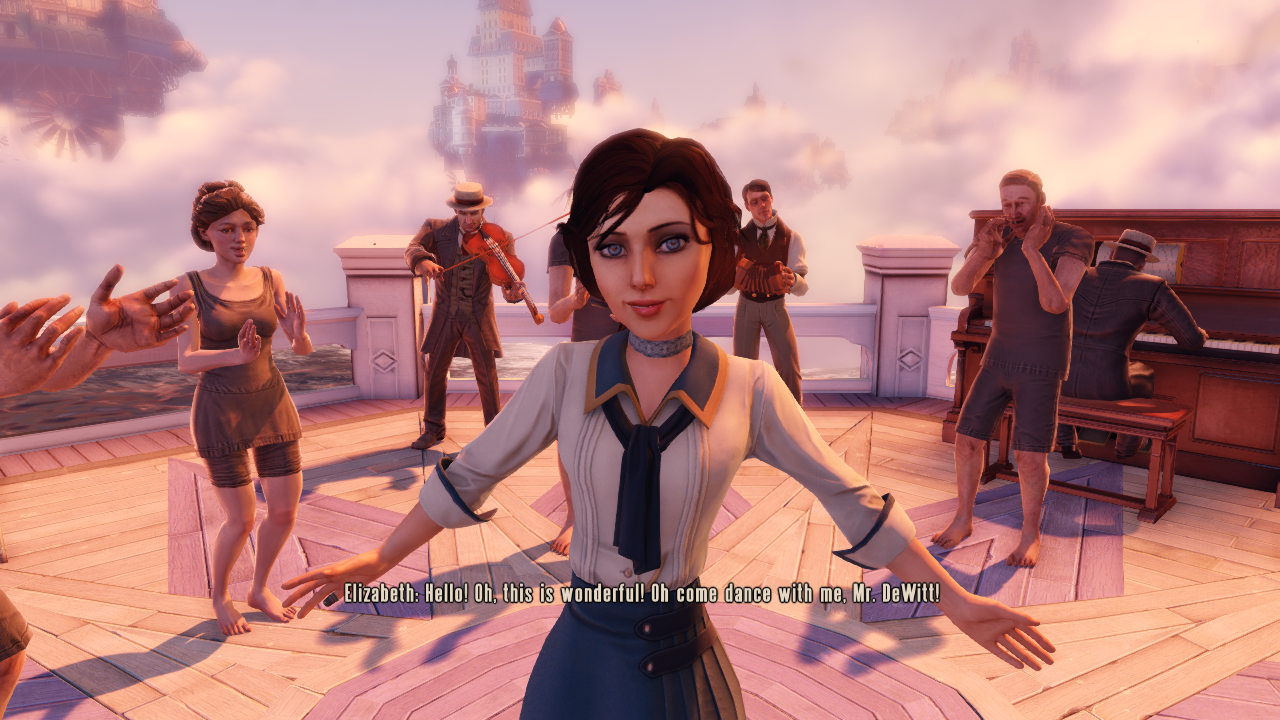
Except Infinite changed the formula altogether. Elizabeth is actually incredibly useful, constantly finding supplies to help us, and money lying around. Not only that, but the way her features were so expressive. 
 She is also one of the characters to undergo massive developments as a character for the duration of the game.


 Design of this calibre was unheard of and unseen for the most part in games those days, often seen only in rare instances and in pre rendered cutscenes than in actual gameplay.

One really has to appreciate the amount of work that has gone into this. 


Overall the game is phenomenal with incredible graphics, a riveting story and a cast of characters that make the world of Columbia truly lifelike, for better and for worse. 

But the game doesn't end there. 

At the end of the game, Booker and Elizabeth make their way to the underwater city of Rapture. We find it in the state of disrepair that we're accustomed to, and head not into the city, but towards the entrance to the lighthouse. Here, the player enters the final area of the game, and the main message of the whole world starts to present itself: Constants and Variables. 

It is best said in these words:

The world that you exist in is made up of the choices you make and the events that take place. Small minor changes can affect the whole of reality and change the course of history altogether. 
We see this best with the Lutece "twins", as in one reality they are born Robert, while in another, they are born Rosalind, the difference between them being a single chromosome.
We consider these as "Variables". Sounds simple enough. 
On the other side, you have "constants". Events and choices that will be made, regardless of everything preceding them. We're not talking about trivial things such as "If I toss a coin it WILL come back down", rather events on a grander scale. 

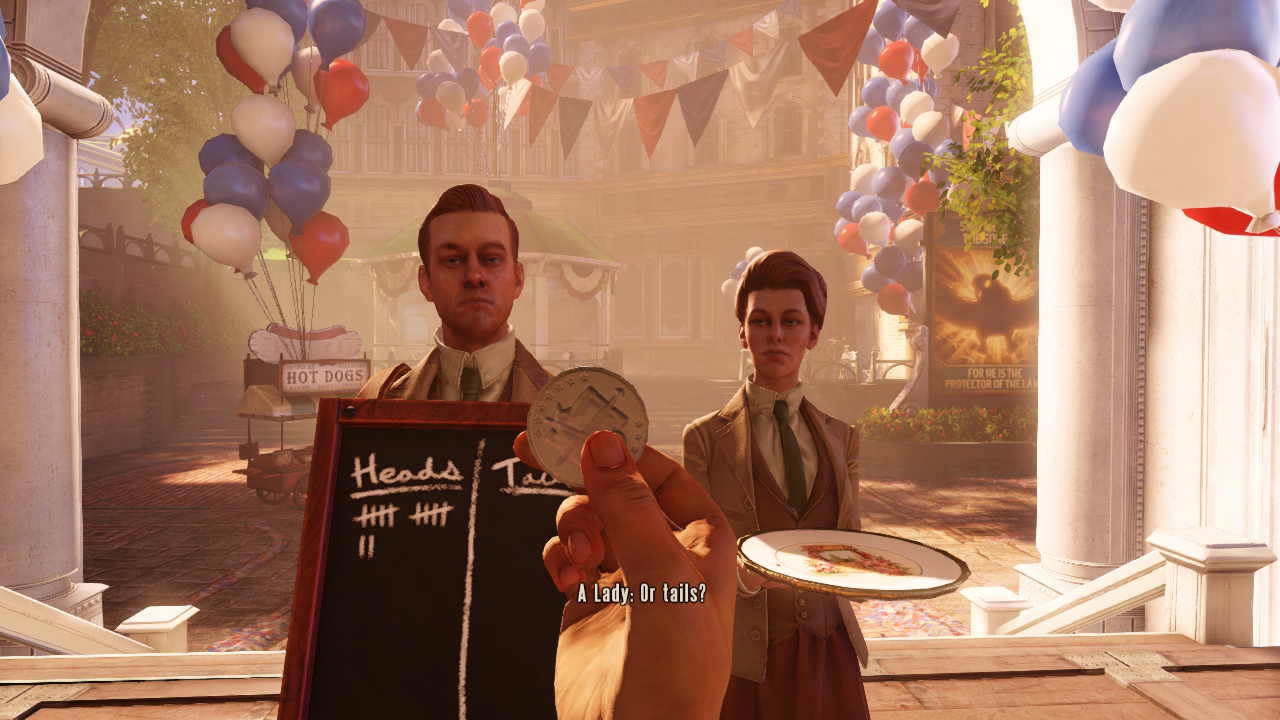
We get small glimpses into this with events within the game itself. The first time you meet the Lutece twins on Columbia, they ask you to flip a coin. 
Judging by their board, it seems to always come down heads. THAT is a constant (although in reality that would be a variable) 
But when you look at the overall story of the series, you are reminded of the quote said by Elizabeth at the end of the game.

"There is always a lighthouse, 
there is always a man,
and there is always a city."

We started both BioShock and Infinite's journey with the lighthouse, and we went to an impossible city. This is one of the biggest themes of BioShock Infinite, and it hits home every single time you play through it. 

We apply the constants and variables principle to the game for a moment and we see the parallels from these two realities. 
So now we return to Rapture for a moment.

A thing to remember: Infinite's story takes place in 1912, and BioShock's story takes place in 1960. In the second downloadable content, the story continues from the end of BioShock Infinite, with the main characters still being Booker and Elizabeth, however this time they're in Rapture, BEFORE the New Year's Revolt, before Rapture fell into ruin. 

The player gets to witness Rapture in its glory days, when it too shone as brightly as Columbia did, when there were no leaks in the walls, when there weren't splicers trying to kill you at every turn, and when the city was properly a utopia as designed by Andrew Ryan. We get to see pre-revolt rapture only in the introduction of BioShock 2, and that too, only briefly. 

The DLC, titled "Burial at sea" comes in two parts. Part one deals with Booker and Elizabeth trying to find a girl named Sally, who had been missing for a few days, and we have to searching for her. In the process, we revisit some old favourite characters, such as the Houdini Splicers, Sander Cohen, and Atlas. 

The DLC, both part 1 and part 2 are incredibly important to the whole storyline of the franchise, but from the perspective of deep lore. In this DLC we get into details from the three games about how the little sisters were made and how the big daddies were conditioned to be fiercely loyal to the little sisters, while in Rapture. We also make a momentary return to the wide open spaces of Columbia after dealing with the claustrophobic environment of Rapture, where we learn how Vigors were made, how Fink stole technology, and the major background for how events of BioShock Infinite play out. 

Overall, the player finds out how the events of Rapture ties in with the world of Infinite. Its a touching tale but one tinged with sadness. 

Along with this, we also see how Elizabeth has grown since the ending of BioShock Infinite, and the start of the DLC. We see how she has become more like the adults that she has known in her life: vindictive, pessimistic, and how her innocence has long since been lost. Her shift in personality, between the beginning where all she wanted was to go to Paris, to having a bleak, albeit partially true, outlook towards life can be seen with quotes such as "The world values children, not childhood" and "time rots everything, even hope" is seen clearly here than it was in the main game, and it does so in an amazing way. 


The first part of this review dealt with the events of BioShock 1, and the title reflects it. Jack ultimately wins in the game's canon lore, and if he got the good ending, he got to live a happy life for the remainder of his days, with the little sisters whom he rescued with the help of Professor Tennenbaum. 
Lives, Lived, Will Live. 
However, in the Infinite story, there is no hope for the future with our main cast. The Luteces are one of the first casualties in the story, but since they died due to the effect of a tear opening apparatus, they were displaced in time, and space. Father Comstock meets his end at the hands of his counterpart, Dewitt, and Booker himself, sacrifices himself to be drowned at the baptism so that the choice of Comstock never takes place, and the world is a safer place. 
Even Elizabeth, doesn't make it out alive, but she dies content knowing that Jack will come to Rapture, save the sisters and kill Fontaine through the remnants of her powers. 
Dies, Died, Will Die. 


The story of BioShock infinite began with a simple glorified fetch quest to bring a girl to a mysterious person, and ended up being one of the strongest stories ever to be told in gaming of that era. Even today, it is considered one of the great tales told.
However, the gameplay was far too short, and the pacing of the game was all over the place in certain instances.
Infinite is a game that tells a story more than it acts as a game, and in its own right it is quite successful, however it still comes second place to its predecessor, a game that acts more like a game than a simple story. 

The parallels: It has been mentioned above about how the minor choices make a difference in creating a new world based around that, but the implications of that are a lot more than what meets the eye. On second and even third playthroughs, it will become more obvious what I'm trying to not say clearly, but I want to give an example anyway: The columbian equivalent of the Big Daddies were never the Handymen that you see attacking you at random instances, it was Songbird. 

Moreover, the entire series, there are so many fragmented bits of information in the form of audio diaries, recordings, and movie clips, it takes some time for the player to fully appreciate what they're being shown. With Infinite, you can really tell the effort the game makers have put in to make this masterpiece, and on the second playthrough you're able to pick up on subtle nods and small foreshadowing of events. However, it has to be mentioned that there is an entire world, hell, two worlds, available to the player, but only if they look for it themselves. Thus, there is a lot that you miss, in the story that they never told.

Personally I recommend this series to all people, be they new to gaming as a whole, or even veterans. This kind of storytelling isn't something that you come across except in the rare occasions. Now, with the focus being slowly shifted to single round games or battle royale style gaming, we see a lack of new games with compelling storytelling alongside functional game mechanics. I'm not saying they're not there, I'm just saying that these are few and far in between. 


If you're going to start this series, then I offer two paths:

1) The classic route: BioShock 1, BioShock 2, BioShock 2: Minerva's Den, BioShock Infinite, BioShock Infinite: Burial at Sea Part 1 and Part 2. 

2) My personal recommendation: BioShock Infinite, BioShock 1, BioShock Infinite: Burial at Sea part 1 and Part 2, BioShock 2 and Minerva's Den. 

The second path is the path that took myself, not knowing about the series except that the title was recognisable. It also gave me a proper sense of what the worlds were like: a wide open space appreciable to new players, followed by the claustrophobic and dark setting of Rapture, with the contrast between the two settings only heightening the experience. 

I havent spoken much about BioShock 2, and I'm aware of this. Personally, it is an amazing game, and adds a lot to the narrative of Rapture, however, my focus during this review has always been about the way that Infinite and BioShock tie into each other, how canonical lore talks about how the two worlds benefitted from the other by way of tears, and how it was somewhat all interconnected.

The whole series is a telling of a horror story. While one part deals with telling it to us through graphic means and with jumpscares, the other part has us exploring the deeper psychological parts of it. Ironically, it is done in the opposite way to the theme of the games. BioShock, based on a philosophy, deals with the visual aspects more than the emotional ones, while Infinite, based on appearances (the over the top pseudo christianity, the blatant racism, and great amounts of violence) showcases the more philosophical aspects of the horror story being told. 

For anyone who is interested in the FULL Story of the series, including all the subtle details, and every inch of the story, I have a link for a playlist here. Do check it out, if you want. 

A great series, a great game, 
Hoping that people pick it up to play and are just amazed by it :)

Thank you for reading my somewhat longer than usual review.
Let me know what you think :) 

Saturday, 13 April 2019

Lullaby

We've all had days which felt like a long drawn out battle, and who's nights felt like the end of a decade, instead of a single day.
And this is a universal experience. 
Life is a daily battle, and the lullaby can guide the minds to a place of peace where they may rest before the next day begins. 

Anyway.
Let me know what you guys think. :)
Enjoy. :D

Lullaby

Running thoughts and noise abound,
With these we spend our waking days.
To senses, a storm of inputs surround,
As we walk about in a sunlit daze.
To break from task, we travel far,
To the land of sleep, as hearts do slow.
The movies play, of dreams bizarre,
We find new worlds of a realistic faux.
Though I must go to this land of sleep,
It will not be easy or with peace.
So sing me softly to the path so deep,
My Valkyrie, so this day may cease.

Monday, 4 March 2019

Lives, Lived, Will Live.


A while back, a friend of mine and I started the DLC expansion for a game which we both liked, BioShock Infinite. Some of you would be familiar with this game, and some of you may not have. Personally, this series is one of my long-time favourites, but my favourite in this series has to be the first one, so I’ll be talking about that one first for the most part.
So, coming back to my friend. I had asked him to give me running commentary as he played, hoping to indulge in a bit of nostalgia as I remembered my first playthrough of the game as he spoke about it.
For those curious, the DLC (Downloadable content) is called “Burial At Sea, part 1 and part 2”. It acts as a continuation of the story of the first game, simply titled “BioShock”, as well as an aftermath of BioShock Infinite. It ends up acting as a gateway between the two games once you reach part 2 of the DLC. It seems confusing, but it actually ties the whole story of the series into a neat little ribbon, albeit somewhat of a blood soaked and partially mangled ribbon, I’ll admit.
Like I said, I’d be primarily talking about BioShock (the first game) in this post, but I will be covering the whole series, especially due to the impact on the story because of the DLC.

So, lets begin.


BioShock is a first person shooter game, with role playing elements, developed by Irrational Games (initially named 2K Boston), and 2K Australia. It was released in the 2007-2008 period for Windows, Xbox and the playstation, and on looking at those dates, you notice that this game is at least a decade old.

The setting for BioShock is the 1960. In the real world, around about that time, we had the discovery of the double helix structure of DNA and the invention of the first transistor computer. This lends itself to a large amount of the setting, and vast amounts of this time period is noticeable in the game, from the design of the clothes, to the subtle political nuances found in Rapture.

But what is Rapture, you ask? Almost all of the first two games (BioShock 1 and 2) takes place in the underwater city of Rapture. The brain child of the fictional character, Andrew Ryan (a character based heavily off John Galt from Ayn Rand’s “Atlas Shrugged”), it is masterpiece in its design itself. Resembling a city from the 1950’s to 1960’s, it serves as the birthplace for a utopian society, however the instant you look inside, we notice that nothing is as what it seems.

Dark, damp and mouldy at best, the inside of the city is mostly broken down, with security robots running amok, it looks like the exact opposite to what a utopia is. Despite this, the city looks spectacular, and what one would imagine an underwater city falling into disrepair would seem like.

Even though the game is marketed as a first person shooter game, thanks to its setting, it ends up becoming more like a survival horror game, which works out in its favour. You have rooms which are randomly flooded, debris strewn everywhere, and the overall ambience sets the player on edge from the instant they step foot into the city.


So lets start at the beginning.

NOTE: Andrew Ryan's outlook towards life, is called "Objectivism", an ideology developed by Author, Ayn Rand, describing it in her own words as, "the concept of man as a heroic being, with his own happiness as the moral purpose of his life, with productive achievement as his noblest activity, and reason as his only absolute"


Whats to like about this game?

PROS:

1.       The visuals. The first thing that most people notice when they start playing the game is the appearance of the City of Rapture. The sheer enormity of it, fleshed out in the style of a 1950’s American city, is something that would have been astounding a decade ago.
When you go inside the city, and see the blend of what the city would have looked like at its peak, and how its fallen to ruin now, you really get immersed into the story.
TEN years later, the visuals still don’t fail to amaze players, both old and new, as they make their way through rapture.

BioShock has been described as “the sign of the coming of age of video games as an artistic medium”. Vox, in 2016, said that BioShock was the first game that showcased that video games could be a work of art in itself. High praise, and one that BioShock has managed to live up to.

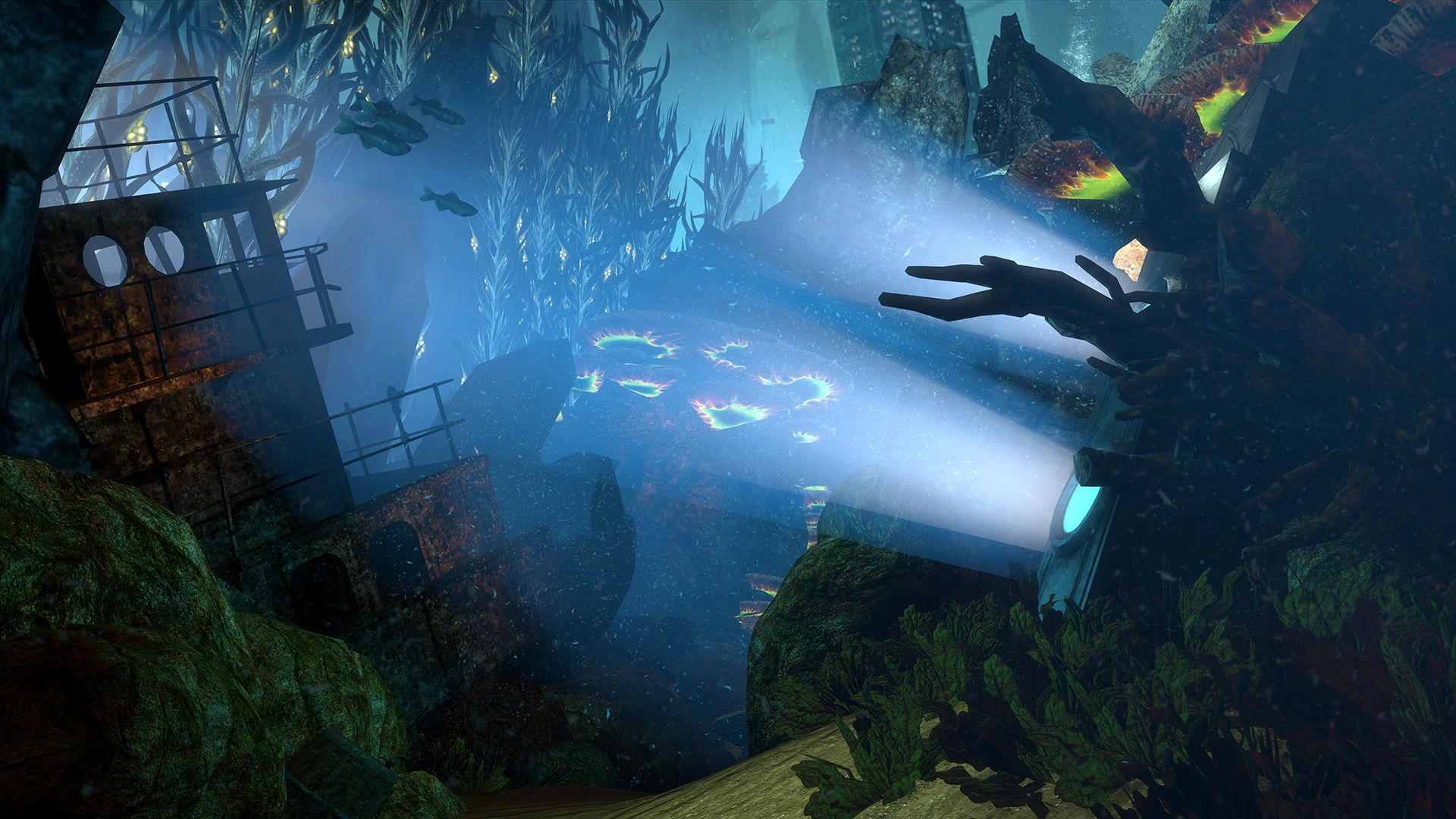
In BioShock 2, we revisit the city of Rapture, but we visit all new areas, with focuses being the residential areas, and where the common and the non-wealthy lived their lives. An especially notable segment is where you get to see things through rose coloured glasses, when you play as a Little Sister (read on) briefly. We even get to see the ocean floor on which Rapture is built. 


Splicers to the side, a Little Sister in the front,
and a Big Daddy at the top of the stairs.
2.       The characters. While BioShock IS known for its visuals, there are two fields which are notably more iconic. The character you encounter being the first one. The instant you set foot in Rapture, you’re greeted by someone you cant see, only to see them murdered by someone dropping from the ceiling. The subtitles say just say “splicers”, your main enemies in this game.

Further in, you meet the Little Sisters and the Big Daddies, two character models that have become so entirely synonymous with this series that the mention of “BioShock” has people thinking of this: (insert image)
The development of these characters, both in-game, and in real life is something that is equal parts horrifying and gripping, as well as incredibly well planned and developed.

Beyond that, you have the main antagonists: Andrew Ryan (the creator of Rapture), and Frank Fontaine. Ryan is easily one of the more complex characters you see in this game, and if you pay attention to your surroundings, you learn more about him, as well as the creation and development of Rapture.
He is such a powerful character, with a compelling back story, with a great deal of emphasis on how he became what he was. He is the reason for the infamous “A man chooses, A slave obeys” quote.
And on the other side of the antagonist coin, you have Frank Fontaine. While he isn’t as impressive as Ryan, he is still a force to be reckoned with in his own right. Fontaine got his status from getting others to do his work for him, much like Ryan did, however, instead of doing it through more legitimate ways, he chose the underground path, stopping at almost nothing to get his end goal: control over Rapture.

And that’s where we come in: The Main Character. Known only as Jack, the person we play as is a silent protagonist, who’s face is never seen in ANY material, in ANY of the games. His origin story, is easily one of the biggest themes of the later part of the game.
 The protagonist of the second game, A Big Daddy, known simply as Subject Delta, is equally interesting, especially his origin story. While in the second game, you look for the little sister you’ve bonded to, the background elements of the story is essentially the back story of the main character.

3.       The Story, and Choices.
In today’s day, we have games such as Assassin’s Creed Odyssey, where every single choice we make as a character affects the overarching game. But games like this was released either last year, with few games from previous years having this level of freedom in making our choices count.
There have been games which preceded BioShock that had multiple endings depending on some choice made, but those were usually restricted to the choices made at the very end of the game. With BioShock, we were allowed to be the “bad guy” from the very beginning. In BioShock 2, the choices made more of a difference than before, as each choice made changed parts of the narrative altogether, including when we let a character from earlier live instead of killing them. The choice mattered for the overall experience of the game as we progressed through it.
Now, BioShock is known for its story, more than anything else, and its plot twist element revolving around the phrase, “Would You Kindly?” has been called one of the strongest narrative elements of recent games. This phrase is important for more than the sake of a plot twist however, in that it subverts the expectation that the player had ANY control over the events of the game.
It seems somewhat contradictory, especially since I mentioned that choices mattered, but you should also keep in mind, that only some instances in the narration have choices while the others are essentially set in stone. It’ll make a lot more sense when you play the game and progress to the point that you meet Andrew Ryan in-game.
Again, drawing attention to the fact that this was TEN years ago, BioShock played a much more important role in games, and influenced media and culture with its amazing and strong narration.

4.       This last one, is my personal favourite.  The Music.
For me, the experience of playing BioShock was somewhat troubling, since I went from the wide open spaces of Infinite and Columbia, to the closed off spaces in Rapture, and not the other way around, and the effect was claustrophobic.
However, it wasn’t the visuals alone that helped me get to that level of immersed in the game. It was the music.
In the game, we have a character called Sander Cohen, a poet, composer, sculptor and playwright of Rapture. He became a leading figure of art in Rapture, but unfortunately, during the descent of Rapture into chaos, so too did Cohen descend into insanity, brutality and apathy. You can see his “work” around parts of Rapture, in the form of Splicers who have been covered with plaster, “immortalised” in a sense, for the spirit of his art.
The music video provided above is Cohen's Theme (Sorry, alignment issue for some reason)
There are many other instances like this, where the musical theme helps in the immersion of the player, most notably the quick moving and high pitched violin noises heard during combat, which heightens the tension as combat begins or continues, as seen here:

You learn more about the world that the player is in, through Audio diaries, some of them utterly heart breaking, such as one by a mother, who's looking for her child, whom she sees has been turned into a Little Sister. This adds a massive level of immersion to the world around you, and you can listen to these recordings by the residents of Rapture as you progress through the city, without it disrupting the flow of the game.
Most games tend to have expositional dumps in some of the cutscenes, and others tend to over flood info by having it given to the player as snippets of texts available that one can collect.
With this, it adds more realism to the world at hand, and allows the player to sympathise with a lot of the characters we come across in the game, including those in the origins of the main characters.


Of Course, there are things that I’m not entirely happy about either.

CONS


1)      The remasters.
In September 2016, the original two games were remastered with better textures, lighting and a general face lift, and released to the world, along with their DLCs, and BioShock Infinite (not receiving any remastering, since it was still quite recent in terms of visuals), and IT’S DLCs. Not complaining about this part.
The part that I AM complaining about is this: The games, for the most part, are available for PC players only on Steam. The game gets through the opening cutscenes of the two remastered games, and takes its sweet time giving control to the players.
Problem? In BioShock 1, it means that the player has already drowned in the plane crash since he stayed underwater for too long, and in BioShock 2, the game basically just quits without any notification in random instances.
These are supposed to be the remastered games, not the originals.
Even high end PCs are having issues regarding this, and two years later, the issue still has not been fixed.

2)      The Gameplay mechanics.As mentioned above, I've played this game after I played BioShock Infinite, and the mechanics of that game were an evolution of this one. Unlike with Infinite, and even BioShock 2, in this game, you are never wielding a weapon, as well as a plasmid at the same time, so things like combinations are a bit more difficult to pull off. There also isnt a lot of maneuverability in Rapture, and you have to move only in the paths prescribed to you. It isnt a massive issue, but due to the order in which I played the games, it is remarkably noticeable. 


A few things to mention as I close this. 
This first game has a lot of its influence from Ayn Rand's books, specifically, "Atlas Shrugged". Andrew Ryan is based off John Galt, and a lot of the events mirror the events from the book at their most basic level. The whole philosophy of Ryan, as mentioned in the image here, is based off Rand's own personal belief. 
Ryan's origins mirror that of Rand's as well: they were both born in Russia and emigrated to America after their home country adopted a communist regime, and both believed in the philosophy of objectivism. 
There are a lot of other topics which are covered in the game, heavy topics, which dont make it to the foreground of the narrative, but are ever present in the very framework of Rapture, a lot of it based on the works of Ayn Rand (Andrew Ryan is an anagram of "We R Ayn Rand")
There are a lot of easter eggs which would be fun to go through, but maybe not right now. 

There are other characters not mentioned, because their role in the game is that of developing parts of Rapture, such as Dr. Yi Suchong, who made the plasmids, the big daddies and little sisters, and those I have not mentioned as they play their roles more in the background than the ones mentioned above.

It is recommended that the player try and find all the audio diaries, as this will uncover a much greater narration, than what you play through, the story of Rapture as a whole. You get to events in the story that happen before the entry of the player, the New Year's Party of 1959, which marked the beginning of the downfall of Rapture, being the most important and notable one. 


All in all, I’ve loved this series since I started playing it with BioShock Infinite, after my surgery, and getting into the rest of the series has been an utter delight.
Hopefully new players also find the series as fun as I have, and have their own takes on lore, events and characters.
This game has survived will into the future, having lasted 10 years, not as an eyesore or someone's nostalgia trip, but as a classic, one which still influences the gaming world and the culture of game design as a whole. 


In my next post (hopefully... these things tend to take a lot of time, and things usually come up in between), I'll be talking about BioShock Infinite, as well as the DLC my friend was playing. 


Let me know what you think please. :) 
On the write up, and on the game series.